
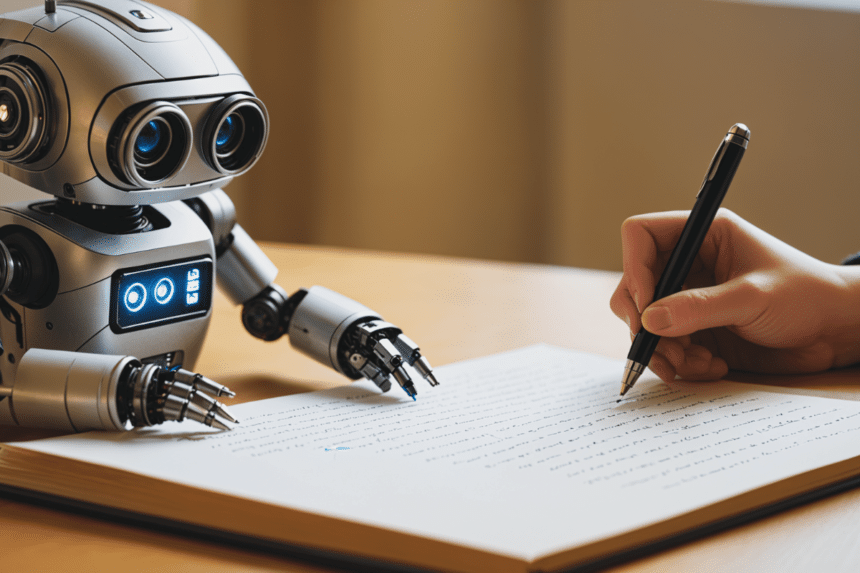
The Death of the Blank Page What Every Malaysian Needs to Know About the AI writing assistant guide
You know the feeling. Monday morning. 9.15A.M. You are looking at that blinking cursor on a blank Google doc. You need to bang out a proposal, an email, maybe a blog post even. The coffee is hot but your brain is still cold. Suddenly you open ChatGPT or whatever other AI text generation service you are using. Thirty seconds later, you have a draft. Not perfect. But something. That is the reality we all live now. We are not tech geniuses and prompt engineers. We are just people trying to do our jobs faster so we can go back home early. This is not some “how you can master AI” kind of guide, that is so boring. This guide is just me, a user breaking down how the AI writing assistant guide works in 2025 for us average Malaysians.
Why Your Old “Copy Paste” Method Is Failing

Remember the good old days? You’d Google a topic, copy a paragraph and then spend the next hour changing the words around so they don’t look plagiarised – that was such a chore. We used AI paraphrasing tools like Quillbot just to spin the damn text.
But that was then. Today, AI content generation tools are different in that they “think” (in a manner of speaking). They don’t go out and pick up a sentence off a website. Instead they predict what the next word ought to be based on millions of examples. Google Search gives you links – you still have to read, filter and write. AI Writing gives you the first draft – you just have to edit and approve. For a Malaysian office worker this change is huge. Now you no longer need to feel “writer’s block” if you have to write a report in English or BM. All you need is a starting point.
The “Mamak Shop” Strategy: Finding Your AI writing assistant guide Flow
Let me tell you how I actually use this stuff. I don’t use one tool. I use a flow. Think of it like ordering teh tarik: The Order: You give the instruction (Prompt). The Making: The AI does the work. The “Kaw” (Strong): You adjust it to your taste. Here is my actual AI article writing workflow for everyday tasks:
Step 1: Brain Dump (Using ChatGPT or Copy.ai) I just type keywords. Let’s say I need content about “KL travel tips.” I ask the AI to give me 10 messy headings and don’t care about grammar here. I just want ideas. Step 2: The Expansion (Using Jasper or Writesonic) Once I have the headings, I use blog writing AI tools to write the rough paragraphs. I tell it to write like a friend explaining things. Don’t let it use big words. Step 3: The Local Edit (Human Brain) This is the most important step. AI doesn’t know that “jalan” is jammed at 5 PM. It doesn’t know the difference between “Nasi Lemak bungkus” and “Dining in.” I add the Malaysia context. If you follow this AI writing assistant guide, you will realise the AI does the heavy lifting, but you do the smart work.
How to Not Sound Like a Robot

There’s a fancy term in tech at the moment: prompt engineering for writing. Scary, right? It ain’t. Prompt engineering is just learning how to talk to your AI so it doesn’t give you corporate rubbish. Most people type: “Write an email about a late project.” AI writes: “Dear Sir, I am writing to respectfully inform you regarding the delayed deliverables…” (Boring!). Instead use this style (The Malaysian way) “Bro, write a polite email to my boss. The project is late because the server down. We need two more days. Don’t be too formal, but don’t be too relaxedalso.
See the difference? AI responds to: tone and context. To get good at SEO content writing with AI, you don’t need to stuff keywords. You need to tell the AI who is reading. If you’re writing for aunties selling kuih, use short sentences. You’re writing for corporate lawyers, use a stricter tone. If you take one thing from this AI writing assistant guide, let it be this: Be specific about how you want it to sound.
The Cheat Codes: Specific Tools That Actually Work
We do not need to go into detail about what tools are available, as doing so will only create confusion; thus, we will stay focused on providing examples of tools that you may use on a regular basis. Students/writers should have access to AI-based grammar and editing tools. For example, many people have heard of Grammarly, but it is also possible to use an AI-based paraphrasing tool as a means of enhancing the logical flow of your writing. As example changing “The meeting took place” to “We had a meeting” is an example of making a minor adjustment to text that will significantly alter the meaning of the statement.
For marketers, if you have a Facebook page or TikTok store. There are several AI-based marketing copy writing tools available to assist. As a result, many online platforms now have caption-generating tools. Therefore, you can create 10 different captions for one caption without having to create a new caption. If you are a small business owner, and you operate a blog with a picture of your product posted, then, by utilizing content automation tools to connect AI programs to your blog, you can create a draft for every post you write containing an image of your products, which may save you hundreds of hours each year. Many individuals have heard of BidaTech AI and its ability to create backend products used for the purpose of workflow automation, but for you, the only thing that matters is whether the product works.
The Future is Not “AI Writers” but “AI Writing Assistants”

There exists a significant dichotomy between employing artificial intelligence to supplant you as opposed to capitalising on AI as your assistant. AI Copywriting tools are fantastic tools. However, incorporating any given copywriting tool into AI does not guarantee that it will have any knowledge of your customer’s distaste for the colour blue, nor will they have any knowledge of your bosses’ fondness for using the exact same emoji in group text messages.
This is why we regard AI as a “guide” or an “assistant.” The predominant AI writing practice in Malaysia consists of adhering to a single principle: Human authentication of AI creation. While the AI system manages the development of all types of written work, the human manages the development of all types of heart-related tasks. As Malaysians, we have the fortune of speaking “Manglish” and of being bilingual, there are linguistically trained AI models based on American English that exhibit a degree of artificiality within their content. With the aid of AI writing assistance tools, we have the ability to instruct these tools to use a tone of “warmth” or “friendliness,” resulting in an end product that more accurately reflects our cultural local ambient characteristics instead of that “cold” American business-sounding tone.