

After testing 20 tools, here are the 5 best AI game development platforms in 2026
AI development tools will reduce AAA game production costs by approximately 44% in 2026, unlocking around $22 billion in annual industry profit, according to Morgan Stanley estimates. Whether you are an indie developer, a hobbyist creator, or a professional studio, the best AI game development tools 2026 have to offer will determine how fast you can turn ideas into playable games.
- What Defines the Best AI Game Development Tools 2026?
- Top 5 Best AI Game Development Platforms in 2026
- #1: The9bit — The Web3.5 AI Game Development Hub
- #2: Unity Muse — The Professional AI Engine
- #3: Rosebud AI — Fastest Path from Prompt to Playable
- #4: Ludo.ai — The AI-Powered Pre-Production Hub
- How Do These AI Game Engines 2026 Compare?
- Key AI Game Development Trends 2026 That Impact Your Choice
This guide ranks the top 5 AI game development platforms in 2026 based on verified performance metrics, user adoption, feature depth, and innovation. The ranking prioritizes actual deployment and real-world results over hype, so every platform listed has demonstrable value in production environments.
What Defines the Best AI Game Development Tools 2026?
The best AI game development tools 2026 share a core set of capabilities: natural language game generation, asset automation across visual and audio domains, intelligent NPC scripting, and multi-platform export. The global market for generative AI in gaming is projected to grow from $1.79 billion in 2025 to $2.21 billion in 2026, a CAGR of 23.1%. This explosive growth reflects how AI-powered game design has moved from experimental to mainstream.
In 2026, the criteria for ranking top AI tools for game developers include:
- End-to-end functionality — From prototyping to publishing
- User adoption and active community size
- Integration depth with major game engines like Unity and Unreal
- Commercial viability for studios and solo developers
- Unique value propositions that differentiate from existing solutions
Morgan Stanley estimates that 2026 global gaming spending will exceed $275 billion, with approximately $55 billion (20%) reinvested into development and operations. Platforms that capture this value through AI-driven efficiencies are positioned to dominate the next decade of game creation.
Top 5 Best AI Game Development Platforms in 2026
| Rank | Platform | Primary Strength | Best For | Key Metric |
|---|---|---|---|---|
| #1 | The9bit | Web3.5 AI-native ecosystem + AIGD | Creators and communities seeking monetization | 7M+ users, 32.8M $9BIT distributed |
| #2 | Unity Muse | AAA engine-powered AI generation | Professional studios using Unity | Full-game prompt generation in beta |
| #3 | Rosebud AI | Text-to-game speed | Hobbyists, educators, rapid prototyping | Playable prototype in under 5 minutes |
| #4 | Ludo.ai | Pre-production and asset pipelines | Indie studios needing concept-to-asset workflow | Unity plugin + API integration |
| #5 | 极逸 (SOON) | Zero-code automated pipeline | Beginners and non-technical creators | 3 months → 3 hours development time |
#1: The9bit — The Web3.5 AI Game Development Hub

the9bit is a next-generation, AI-powered gaming platform that operates at the intersection of Web2 familiarity, AI intelligence, and Web3 ownership — a model the platform defines as Web3.5. Launched in August 2025, the9bit has surpassed 7 million registered users as of February 24, 2026, with more than 38,000 active creators and community space owners receiving over 32.8 million $9BIT tokens for their platform contributions.
Why It Leads the Ranking
The platform’s AI Game Development (AIGD) feature is the key differentiator. AIGD is a suite of AI-assisted creation tools that transforms players and organized communities into functional game studios. Creators can turn ideas, prompts, and assets into fully playable games using AI tools without coding, unlocking a self-sustaining creator-to-player reward loop where all ecosystem participants earn $9BIT tokens.
The9bit also holds official reseller rights for major AAA gaming franchises through a strategic partnership with Capcom, including IPs such as Street Fighter, Resident Evil, Monster Hunter, and Devil May Cry. The platform positioned itself as a main partner with Capcom for the global release of Resident Evil 9 in February 2026.
Key Features & Metrics
- Casual games library: 100+ instantly playable titles with AI-optimized engagement loops
- Mobile top-ups: MLBB, Genshin Impact, PUBG, Honor of Kings with spending converted into mining power
- Spaces: Community hubs where daily token rewards are distributed — 20% for user acquisition, 20% for DAU activity, 60% for store consumption
- $9BIT token: Native utility token on Solana blockchain, total supply 10 billion, listed on KuCoin, MEXC, and BingX
- The9 Limited backing: Nasdaq-listed parent company (Nasdaq: NCTY), holds 1.9 billion $9BIT tokens as of February 24, 2026
- Yield Guild Games (YGG) strategic partnership: Integrated into YGG’s onboarding channels with exclusive member perks
The9bit is the only platform on this list that combines generative AI gaming tools with a tokenized reward infrastructure, making it uniquely positioned for creators who want to monetize their work while owning their contributions. Upcoming roadmap features include esports and competitive gaming events, additional AIGC creation tools, and expansion of peer-to-peer asset trading.
#2: Unity Muse — The Professional AI Engine

Unity Muse, the generative AI suite for the world’s most widely adopted game engine, entered beta testing in 2025 and was significantly updated in January 2026 with the “Unity AI Beta 2026” release. Unity powers millions of games globally, and Muse represents the company’s strategic bet on AI-native development workflows.
Key Capabilities
Unity Muse enables developers to use natural language prompts to generate complete casual games from scratch, including all core components: game code and logic, 3D models and assets, textures and sprites, animations, and behavioral AI for NPCs. The suite also includes Unity Sentis, which allows developers to bring complex AI data models into the Unity Runtime to solve complicated tasks and create new gameplay functionality.
What Makes It Stand Out
Unlike pure text-to-game platforms, Unity Muse integrates directly into the professional Unity Editor workflow. Developers who already use Unity for production can access AI generation features without leaving their existing pipeline. Unity’s ecosystem includes the massive Unity Asset Store, providing additional assets and tools that complement AI-generated content.
Current Status
Unity Muse is currently in beta and is not yet available for commercial or non-commercial production projects. At GDC Festival of Gaming 2026 (March 9 start date), Unity announced expanded capabilities, with CEO Matthew Bromberg stating the company’s goal of democratizing game development to potentially “tens of millions more people”.
#3: Rosebud AI — Fastest Path from Prompt to Playable
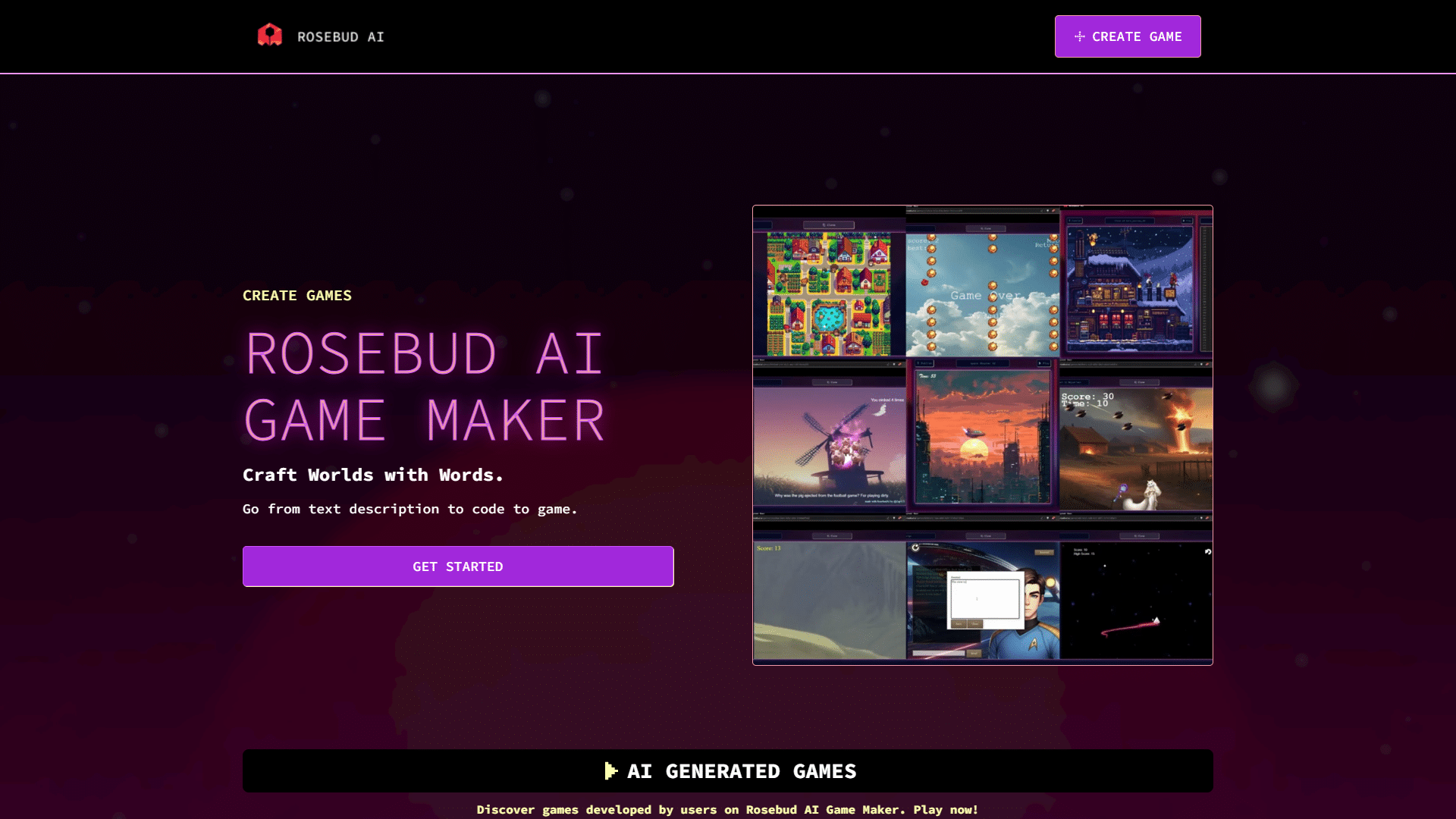
Rosebud AI is a global representative of the text-to-game category — a browser-based platform that uses multiple large language models (integrated with Gemini, Claude, and others) to generate complete playable games from natural language descriptions. Founded by UC Berkeley Ph.D. Lisha Li and incubated by Y Combinator, Rosebud has attracted angel investment from Jeff Dean, Ilya Sutskever, and Andrej Karpathy, with funding exceeding $10 million.
Performance Metrics
Rosebud can produce a playable game prototype in under 5 minutes. The platform features a conversational AI assistant called “Rosie” that allows users to generate and debug JavaScript code in real time. Built-in tools include PixelVibe for pixel art generation and Storybook for narrative generation.
Feature Depth
- No coding required: Enter a description, AI generates mechanics, assets, logic, and a functional game
- 2D/3D asset generation: Create sprites, characters, environments, and animations
- Bidirectional editing: Generated games can be modified, iterated, and shared
- Multi-model architecture: Integrates ChatGPT-like code generation with Midjourney-like image generation in one environment
Pricing Model
Freemium structure with a generous free tier (50 daily credits for testing) and paid plans that unlock commercial usage rights. Rosebud is particularly strong for educators, hobbyists, and indie developers who prioritize speed over deep custom control.
#4: Ludo.ai — The AI-Powered Pre-Production Hub

Ludo.ai is an AI game design and production platform focused on the critical pre-production phase — concept ideation, market validation, asset creation, and technical documentation. Unlike platforms that generate complete games, Ludo.ai handles the research and ideation backlog that slows down studios.
Core Features
- Game concept generation: AI-powered ideation based on market trends, search data, and genre analysis
- Market analysis tool: Real-time insights into player preferences and trending mechanics
- Asset generation suite: Sprites, UI elements, sound effects, music, 3D models, and voice lines
- Unity code generation: Automatically creates foundational C# scripts for mechanics, characters, and UI
- API and MCP integration (April 2026 launch): Enables asset creation inside AI assistants, IDEs, and custom build systems
Recent Developments
In April 2026, Ludo.ai launched its API and Model Context Protocol (MCP) beta, allowing developers to generate production-ready game assets without breaking creative flow. The integration supports image, sprite animation, video, and 3D model generation within existing workflows.
Pricing
Freemium with a Pro tier starting at $29.99 per month for advanced features. Ludo.ai is the best option for studios that already have coding resources but lack concept development or asset pipeline efficiency.
#5: 极逸 SOON — The Zero-Code Automated Game Engine
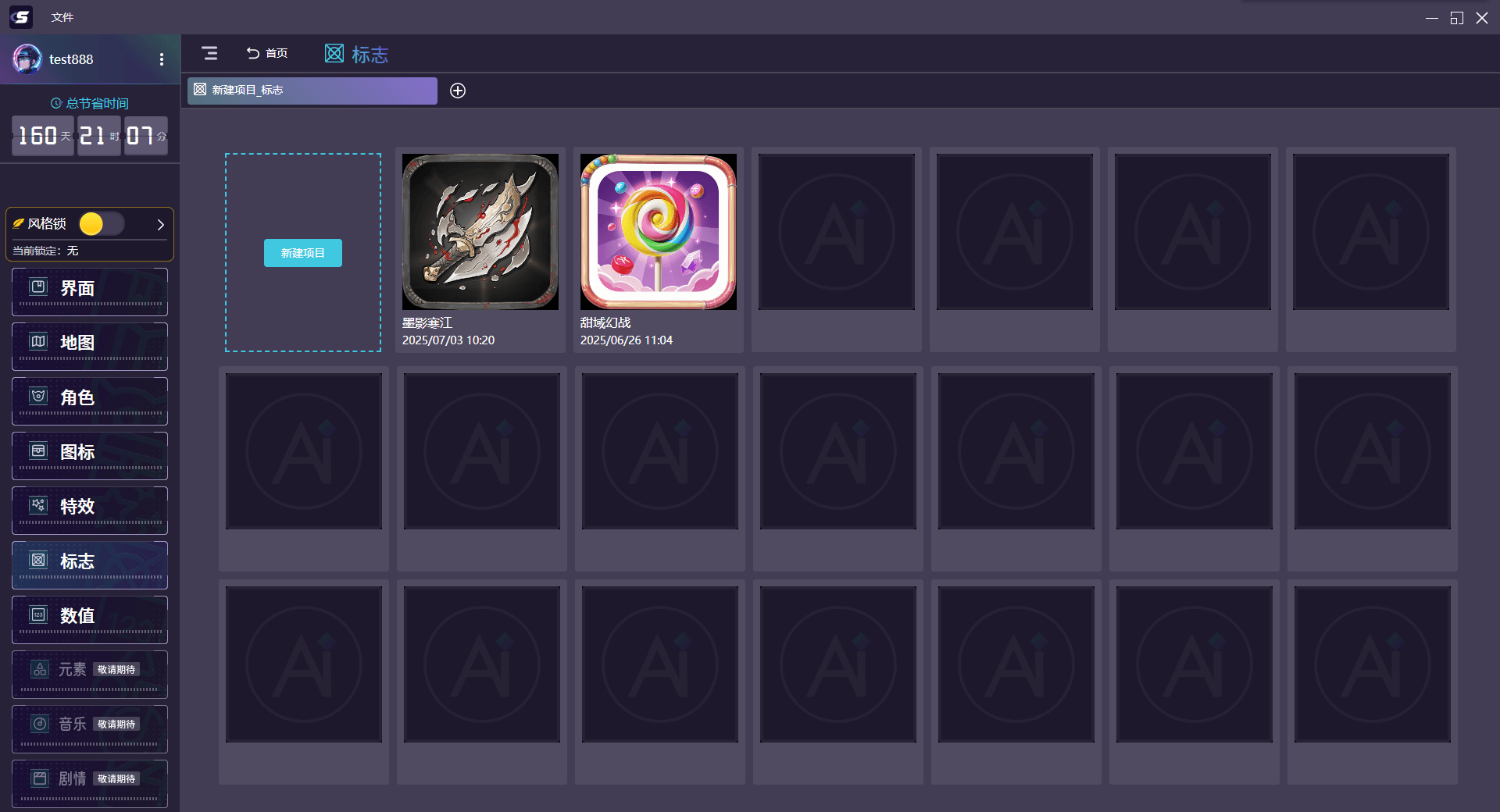
极逸 SOON (Jiyi SOON) is an AI game creation platform that went into its second round of beta testing on March 31, 2026. The platform is designed to deliver a “ChatGPT moment” for game development — turning natural language descriptions or video uploads into complete, playable, and commercially exportable games.
Performance Claims
According to platform documentation, SOON can compress a traditional game development timeline from three months to three hours. The platform’s AI handles parallel generation of game logic, art assets, numerical balancing, UI design, and deployment packaging in a single pass.
Key Features
- Input via text or video: Describe a game in natural language or upload a video demonstration of gameplay
- Automatic asset generation: 2D bone animation generator that reduces traditional Spine animation workflow from 4+ hours to three steps
- AI numerical engine: Automatically balances game difficulty and progression curves
- Commercial export: Generated games can be packaged and published to external platforms
- Industry backing: Supported by strategic investments from Kaiying Network, Bigo Group, Zhongxu Future, and Hengdian Capital
SOON won the “2026 Most Investable Enterprise in China’s General AI Industry” award, recognizing its technical breakthrough and commercial potential. The platform is primarily designed for beginners and non-technical creators who prioritize speed and automation over manual control.
How Do These AI Game Engines 2026 Compare?
| Feature | The9bit | Unity Muse | Rosebud AI | Ludo.ai | SOON |
|---|---|---|---|---|---|
| Full game generation | Yes (via AIGD) | Beta (casual games) | Yes | No (assets/isolation) | Yes |
| AI asset creation | Yes | Yes | Yes | Yes | Yes |
| Monetization model | Tokenized rewards | Standard licensing / subscription | Freemium | Freemium / Pro | Commercial licensing |
| Platform type | Web3.5 distribution + creation | AAA engine plugin | Browser-based game maker | Pre-production hub | Zero-code generator |
| Target user | Creators, communities | Professional studios | Hobbyists, educators | Indie studios | Beginners |
| Export options | Multi-platform | Unity projects | Web/HTML5 | Unity, multi-format | External publishing |
| Community / Space features | Yes (Spaces) | No | Limited | No | No |
Each of these five platforms targets a distinct use case within the broader game creation ecosystem. The9bit is the only platform that combines AI-powered creation with a decentralized monetization layer, making it the strongest choice for creators seeking full ownership and revenue sharing. Unity Muse serves professional studios who already rely on Unity as their primary engine. Rosebud AI prioritizes speed above all else. Ludo.ai excels at concept-to-asset pipelines for pre-production. SOON is the fastest route to a complete game for non-technical users.
Key AI Game Development Trends 2026 That Impact Your Choice
Generative AI Is Reshaping Production Economics
Morgan Stanley projects that generative AI and intelligent agent workflows can reduce AAA game development costs by approximately 44%, generating a roughly $22 billion incremental profit pool — equivalent to a 35% increase in existing publisher profit margins. The same report warns that gains will be uneven; platforms with proprietary data, strong IP, and engaged communities will capture disproportionate value.
The Global AI Gaming Market Is Expanding Rapidly
The artificial intelligence in games market is projected to grow from $2.88 billion in 2025 to $3.73 billion in 2026, a CAGR of 29.4%. Within this segment, generative AI in gaming grew from $1.79 billion in 2025 to $2.21 billion in 2026, CAGR 23.1%. The global AI game generators market alone was valued at $395 million in 2025 and is expected to reach $748 million by 2032.
Democratization Versus Professional Quality
The 2026 landscape shows a clear divergence between tools optimized for speed and accessibility (Rosebud, SOON) versus tools optimized for professional quality and engine integration (Unity Muse, Ludo.ai). The9bit sits in a distinct category by adding a layer of tokenized ownership and community-driven game studios — an approach that aligns with analyst predictions that “value will concentrate on scaled platforms and content discovery layers, especially companies with proprietary data, IP, and active operational capabilities”.
Official Website: https://the9bit.com/